
Google's Cyclone AI Buys an Extra Day
WeatherNext forecasts a cyclone's track and strength a full day earlier than before, and Google is open sourcing the model.
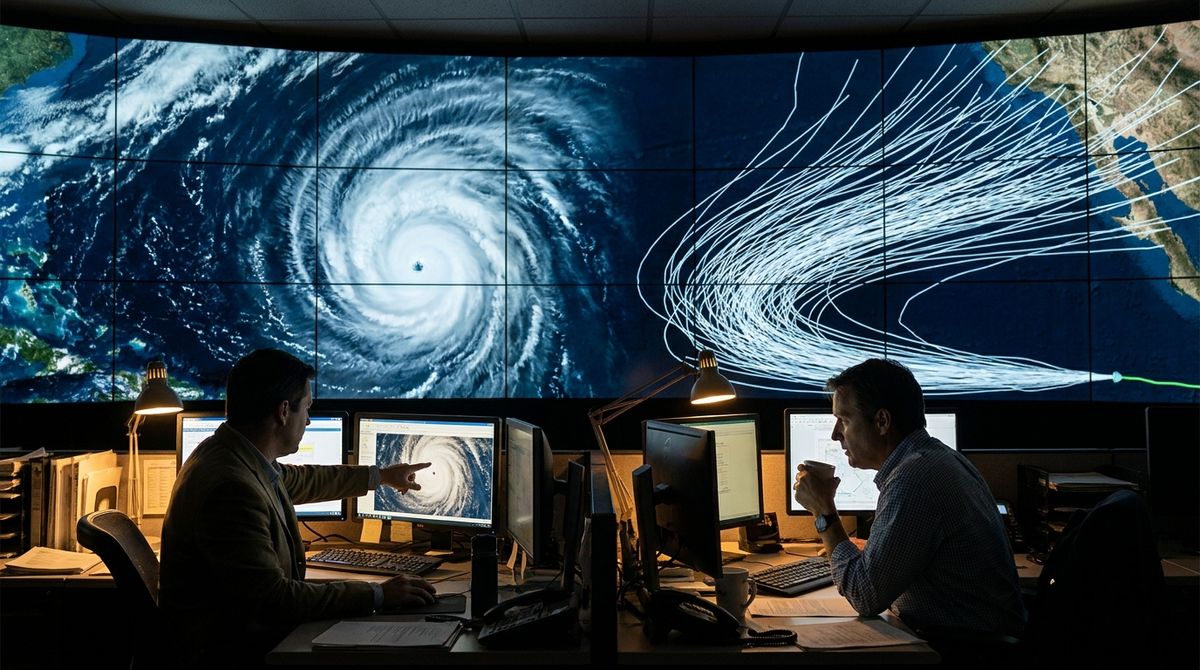
When a hurricane is bearing down, the difference between a two-day and a three-day warning is measured in evacuated neighborhoods and boarded-up windows. Every hour of lead time gives people more room to prepare. That is what makes Google DeepMind's latest claim worth a look: its WeatherNext AI model, described in a new paper in Nature, can hand forecasters roughly an extra day of accurate warning for tropical cyclones.
What it is
Tropical cyclones (the storms also called hurricanes or typhoons) are hard to predict because two different things matter at once. There is the storm's track, meaning where it goes, which is pushed around by huge global air currents. And there is its intensity, meaning how strong it gets, which comes from small-scale physics churning around the storm's core. Traditionally those needed two separate kinds of computer model: coarse global ones for the path, fine-detail local ones for the strength.
WeatherNext is a single AI model that predicts track, intensity, and wind structure together. It was trained on nearly 20 terabytes of global atmospheric data plus IBTrACS, a historical database covering close to 5,000 past storms. To capture uncertainty, it runs an ensemble, meaning many slightly different forecasts at once. This year that means 1,000 possible scenarios per storm, up from 50 last year, which helps flag rare but dangerous events like rapid intensification. It can produce a 15-day forecast in under a minute on a single TPU chip.
Why it matters
The headline number is the extra day. Tested against historical storms from 2023 and 2024, WeatherNext's three-day forecasts were about as accurate as older models managed at two days. Google frames that jump as roughly a decade's worth of normal meteorological progress, based on how forecast accuracy has improved over the past 20 years.
It is not just a benchmark. During the 2025 season, the model helped the US National Hurricane Center make what Google calls a historic forecast for Hurricane Melissa, predicting its rapid strengthening and landfall in Jamaica in time for an advance warning. The work was done with the NHC, the Cooperative Institute for Research in the Atmosphere, the UK Met Office, and other agencies, a useful credibility signal for a claim coming from a tech company rather than a weather service.
There is also a genuinely surprising twist. Forecasters have long assumed you need very high-resolution data to nail intensity. WeatherNext Cyclones works with data at 28-by-28-kilometer resolution, about 100 times coarser than traditional models, and a smaller version runs at a coarser 111-by-111 kilometers. Even Google's own scientists say they do not fully understand why it works so well at that resolution. They are calling it an open research question, which is a refreshingly honest thing to see in an announcement.
A worthwhile caveat
The impressive results come from Google's own evaluation against other top models, published in Nature but authored by the team behind the tool. The Melissa example is a single, real case rather than a season-long audited scorecard. And the company itself is clear that official warnings should still come from your national weather service, not a demo.
What's next
The most consequential move here may be the giveaway. Google is open sourcing the code and model weights for WeatherNext 2 and WeatherNext Cyclones, plus a compact WeatherNext 2-mini that runs on a single TPU in a free public notebook. Anyone can build on them, from academic labs to national agencies to nonprofits. Forecasts are viewable on Google's Weather Lab, now expanded to show temperature, precipitation, and wind alongside storm tracks.
The pitch is a partnership, not a replacement: fast AI forecasts feeding into the judgment of human forecasters. If the open models hold up outside Google's own tests, the interesting story over the next few storm seasons will be who picks them up, and whether a smaller weather agency can now produce warnings that used to take a supercomputer.