
Apple Bets on Local AI With New Macs
Apple's refreshed Mac mini and Mac Studio are pitched at developers who want to run AI models at home instead of renting cloud tokens.
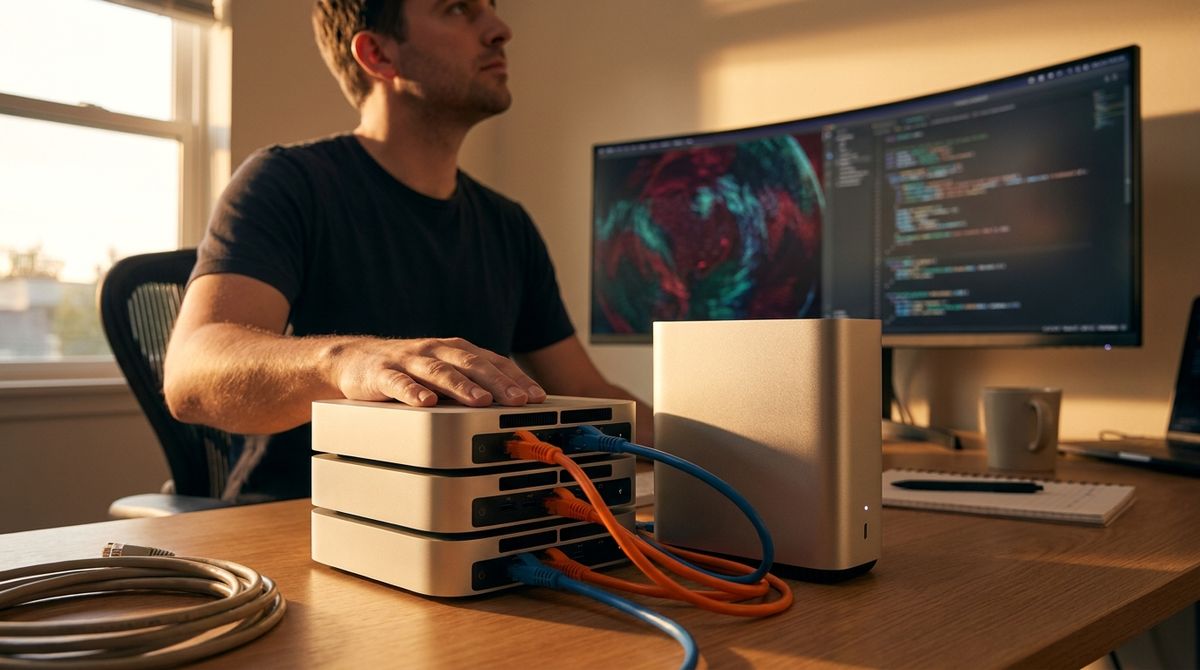
Cloud AI has a billing problem. Developers have folded coding assistants into their daily work, leaning on frontier large language models (the big general-purpose systems behind tools like Claude Code or Codex), and the token bills have started to sting. A token is roughly a chunk of text the model reads or writes, and you pay per token. Run enough of them and the meter never stops.
Apple's latest desktop refresh leans into an alternative: keep the AI on your own machine. The new Mac mini and Mac Studio are being positioned squarely at people who would rather buy the compute once than rent it forever.
What it is
On the surface, these are ordinary desktop upgrades. Both pick up Apple's N1 chip, which adds Wi-Fi 7 and Bluetooth 6. Storage is said to be up to twice as fast, hitting 15GB/s. The Mac mini now ships with 2.5Gb Ethernet as standard, with a 10Gb option for anyone who wants a fatter pipe.
The pricing spread is wide. The Mac mini with the M6 chip starts at $899 with 16GB of memory, and M5 Pro configurations start at $1,699. The Mac Studio with M5 Max starts at $2,499, while M5 Ultra configurations begin at $5,499. Configure them generously and the numbers climb well beyond that.
Preorders open today, with shipping on September 22. One exception: the 512GB memory configuration of the M5 Max won't arrive until late October. The machines ship with macOS 27, nicknamed Golden Gate, which hints the annual software update may land around then for everyone else too.
Why it matters
The real story is memory and the models it can hold. Open-weight models, the kind you can download and run yourself, have gotten good. Recent releases from Qwen and DeepSeek can handle many of the same tasks as the pricey cloud models, and because they're smaller, you can run them on your own hardware using your own electricity instead of paying per token.
The catch is that most everyday hardware still can't fit the bigger, more capable models in memory. A middle-of-the-road MacBook Pro simply runs out of room. So we're not yet living in a world where you casually run everything locally on whatever laptop you happen to own.
That gap is why some developers have started chaining multiple Mac minis or Mac Studios together, pooling their memory and compute to run larger models than any single machine could manage alone. It's a scrappy workaround, and Apple appears to have noticed. A desktop that can be stacked, networked over fast Ethernet, and loaded with large amounts of memory is a natural fit for that crowd.
The trade-off
Running models locally isn't free, it just moves the cost around. Instead of a monthly bill that scales with usage, you pay a big number up front and then feed the machine electricity. For a heavy user, that math can work out. For someone who dabbles, a fully loaded Studio is a lot of hardware to leave idle. And local open-weight models, while capable, are not always a one-to-one replacement for the biggest cloud systems on every task.
Worth flagging: this is the pitch, not a proven verdict. The claims about storage speed and model performance come from the framing around the launch, and how well a given open-weight model matches a given cloud model depends heavily on what you're actually doing.
What's next
The interesting signal here is less about any single spec and more about the direction. Apple is shaping desktop hardware around the idea that serious AI work might increasingly happen on a machine sitting on your desk, or a small cluster of them, rather than in a rented data center. If open-weight models keep closing the gap with frontier systems, the case for owning your own compute only gets stronger. If they stall, these stay excellent desktops that happen to be very good at AI. Either way, the question developers keep asking is whether renting intelligence stays practical, and Apple is quietly offering a way to stop asking.