
A Map of Every DNA Typo
DeepMind precomputed the molecular effects of all 9 billion possible single-letter DNA changes and is letting researchers browse them for free.
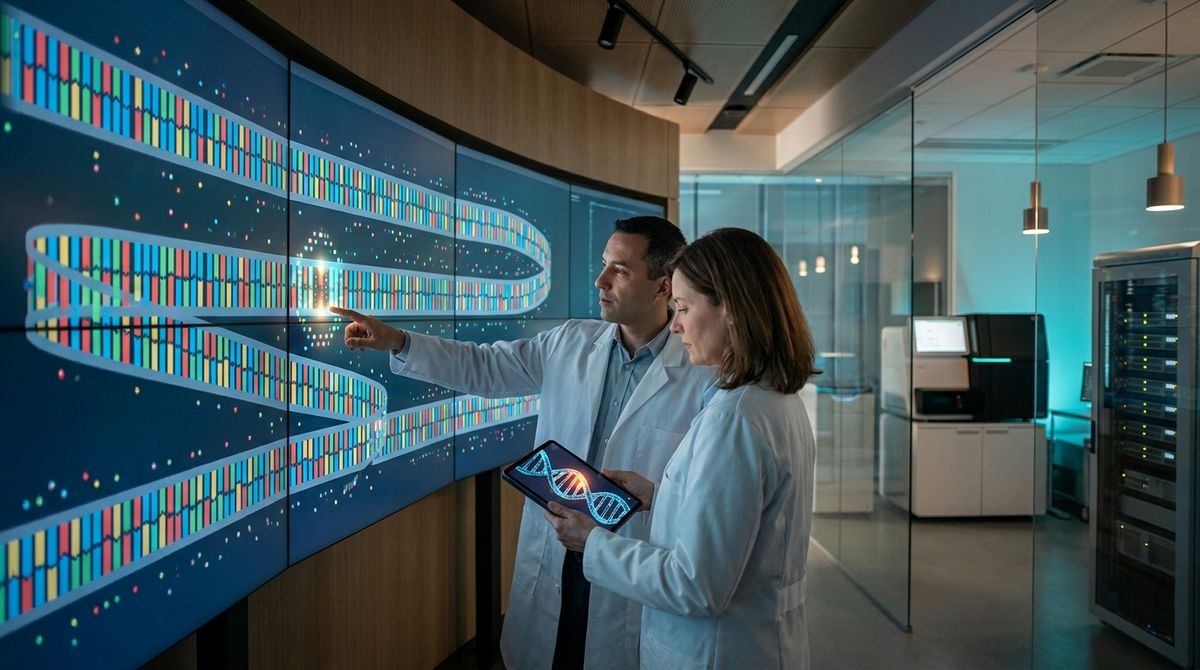
The genome has 9 billion possible typos
Your DNA is a very long instruction manual written in just four letters. Change one letter and you might change nothing at all, or you might trigger a disease. The trouble is scale. There are roughly 9 billion possible single-letter swaps across the human genome, and testing each one in a lab is, to put it mildly, not happening this century.
Google DeepMind's answer is AlphaGenome Atlas, launched today. It is a searchable catalogue of predictions for the molecular effect of every one of those 9 billion single-letter changes, known in the trade as single-nucleotide variants. It builds on AlphaGenome, an AI model that predicts how genetic variants affect biological processes. The new twist is that DeepMind precomputed the answers at scale, so researchers can browse a big-picture view instead of querying variants one at a time.
What is actually in it
The Atlas is a genuinely huge dataset, about 1 petabyte, which DeepMind says is more than 30 times the size of its AlphaFold protein database. For each variant it stores thousands of molecular predictions across hundreds of human and mouse cell types.
To keep that from being overwhelming, there is a single headline number called the AlphaGenome Variant Impact score, or AVI. It combines AlphaGenome with AlphaMissense, DeepMind's model for protein-altering changes, into one figure so researchers can quickly rank which variants matter most. Handily, the score works both in the 2 percent of the genome that codes for proteins and in the other 98 percent, the so-called non-coding regions that switch genes on and off and where most trait-linked variants actually live.
Each score also comes with an explanation. The Atlas breaks the AVI down into contributing factors, such as whether a variant disrupts RNA splicing (how cells edit genetic instructions) or gene expression. There is also a library of more than 2,500 recurring DNA sequences, effectively the genome's repeated words, and where they appear.
Why it matters
The most convincing sign that a tool works is when scientists find things with it. DeepMind cites a few early cases from external collaborators.
In rare disease research with the GREGoR Consortium, a team at the Broad Institute used the AVI score to re-rank variants that earlier studies had missed. They flagged a change in a gene called DNM1, linked to a severe form of epilepsy. The underlying predictions even showed the mechanism: the variant created a faulty splice site that lengthened the resulting protein. Lab experiments backed up the prediction.
On the population side, a Medical Research Council fellow at the University of Exeter applied the Atlas to whole-genome data from more than 54,000 UK Biobank participants. Grouping rare variants by their predicted effects surfaced 22 percent more non-coding associations than would otherwise emerge from the statistical noise, pointing to regulatory variants affecting proteins tied to aging and oxygen sensing. A similar approach on body mass index narrowed the field to 19 genetic regions worth a closer look.
The honest caveats
Worth remembering: these are predictions, not measurements. The Atlas is a giant set of educated guesses that still need experimental validation, which is exactly how the DNM1 example played out. DeepMind frames the whole thing as a baseline rather than a finished map, and says accuracy should improve as the underlying model does. The benchmark claims of best-in-class performance are the company's own, so independent testing will be the real judge.
What is next
The Atlas is free for non-commercial use today through a website portal, an API, and as a skill in Google's agentic tool Antigravity, with commercial access on Google Cloud coming later. DeepMind clearly wants it to become part of a larger, connected toolkit for biologists rather than a standalone lookup table.
The bigger picture is a shift in how genetic research starts. Instead of guessing which of thousands of candidate variants to chase, researchers can begin with a ranked shortlist and a plausible mechanism. That does not replace the lab bench, but it may point the pipette at the right target faster.